
Leadership in Finance Summit 2026 – From Control to Command – Sarah Gitau (CFO VanMoof): “You need to truly understand where your data stops.”

The role of the CFO is shifting from control to direction. But what does that mean in practice, when data is no longer always fully reliable and the future is uncertain? Sarah Gitau, CFO of VanMoof, operates in that tension every day. “Precisely when you have less certainty, you need to think more carefully about how you make decisions.”
How do you, as a CFO, view the tension between data and intuition?
“With nuance, because in practice that tension doesn’t really exist. It’s always a combination. The real question you need to ask yourself is: how much weight do I give to data, and how much to intuition in this specific situation?
And that actually starts with a more fundamental question: how reliable is my data still? Because data feels objective, but it isn’t necessarily so—especially not when the context is changing.”
When does data become less reliable?
“Primarily when the world around you is changing, but your data doesn’t yet reflect that. At VanMoof, for instance, we have a lot of historical data on pricing, marketing promotions and conversion. But a large part of it comes from a number of years ago when we operated fully direct-to-consumer.
Today, we are operating in a completely different reality: much more through retail, with different competitive dynamics and a different customer decision process. You can still use that data—but only as a reference point. You have to, in a way, ‘look through it’ and ask yourself: to what extent does this still apply?”
Lees ook op CFO.nl: Leadership in Finance Summit 2026 – Michel Wessel (CFO Royal Talens): “Ik geloof niet in intuïtie zonder feiten, maar leiderschap begint waar zekerheid ophoudt.”
What does that mean concretely for how you make decisions?
“I almost never work with a single outcome. As CFO, I see it as my role to counterbalance natural bias within organizations—especially commercial optimism. Sales tends to focus on the upside: what if everything goes well? My role is to challenge that: what if it doesn’t?
So instead of one forecast, we work with scenarios: a target, often coming from the business, a base case, which I as CFO can stand behind – and sometimes a downside. That base case is where my intuition and experience weigh more heavily. It’s not purely data—it’s also: what have I seen before, where are the risks, what feels realistic?”
So you use intuition as a corrective mechanism?
“Yes, but a substantiated one. Intuition is not ‘gut feeling without a basis’ for me. It’s built experience. Recognizing patterns. Knowing where things have gone wrong in the past—or where they have worked.
For example, if a forecast fully depends on perfect execution, you already know the risk is high. You don’t always see that directly in the numbers, but you can feel it from experience.”
Lees ook op CFO.nl: Schuldsanering Accell leidt tot herschikking van de aandelen
Is there a moment when you say: we stop analyzing and just act?
“Yes, definitely. Especially with new initiatives. In my previous role at UNGA, we explored a subscription model with kids’ boxes. We did a lot of analysis, but at some point it stopped generating new insights. That’s when you need to take a different step: test it in practice.
But that doesn’t mean you ‘throw everything on intuition’. You limit the risk: you start small, define clear KPIs, and learn as you scale. So you don’t replace analysis – you move it to a different phase.”
So essentially you’re saying: as uncertainty increases, your decision-making model changes?
“Exactly. In stable situations, you can rely heavily on data. It’s about extrapolating and optimizing. But once you move into new or changing environments, that model stops working.
Then you need to work more iteratively. More testing, faster learning. That requires something different from finance as well. You become less the ‘controller of outcomes’ and more the ‘designer of the process through which the organization learns’.”
Lees ook op CFO.nl: Accell Group benoemt Mohammed Hassan tot CFO
What does this require from your team?
“My team is highly data-driven, and that’s essential. But data without interpretation is not enough.
We spend a lot of time what I would call ‘sparring’: what do we see in the data, how does that differ from expectations, and why? What helps is that many people in my team have years of experience in this industry. They bring sector knowledge you won’t find in dashboards.
I bring a broader financial and strategic perspective. The quality of decisions comes from that combination.”
How do you bring the board along in that uncertainty and nuance?
“By being explicit about what you know and what you don’t. We never present a single number as if it were the truth. We show scenarios and explain the assumptions behind them.
But just as importantly, we connect actions to them. So not only: ‘these are the possible outcomes’, but also: if we see these signals, we will adjust – and this is what that looks like. That makes it much more practical. It shifts the conversation from ‘are we right?’ to ‘are we prepared?’”
Lees ook op CFO.nl: Ritchy Drost (CFO VodafoneZiggo) over de jaarcijfers van 2025: “In ons strategisch plan hebben we bewust gekozen om nu te investeren. De eerste resultaten zijn al zichtbaar.”
You mentioned the role of retail earlier. How has that changed your thinking?
“It has added a completely new dimension. In a direct-to-consumer model, behavior is relatively measurable and predictable. In retail, there’s an additional layer: the influence of the salesperson. A retailer’s recommendation can be decisive in the purchase of an e-bike. That means not everything is visible in data anymore.
You also need to invest in things that are less directly measurable: training retailers, relationship management, trust in the brand. As a CFO, that requires you to look beyond just the numbers.”
If you link this to the theme ‘From Control to Command’: where is the shift for you?
“Control is about explaining what has happened. Command is about giving direction to what will happen – even when you don’t have full certainty. That’s a different mindset. It means you need to: accept uncertainty, be explicit about where the risks are, and still make decisions. And perhaps most importantly: not wait for perfect data. Because that moment never comes.”
Lees ook op CFO.nl: CFO Day 2026 – ‘Clarity in Chaos’ – Charlotte Hanneman (CFO van Philips): “Helderheid vraagt ook om een sterke talent- en innovatieagenda.”
What is your key lesson from working in this tension?
“You really need to understand where your data stops. Many people think they are data-driven, but are actually using data outside the context it was meant for. So the real skill is not analyzing – it’s judging when analysis is still meaningful.”
Register now for the Leadership in Finance Summit 2026 (5 oktober – Circuit Zandvoort): “From Control to Command”
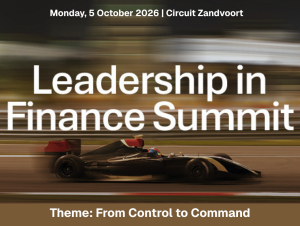
Imagine a Formula 1 circuit. Everything revolves around control: data, sensors, dashboards, engineers. But winning is not driven by data alone.
The difference is made through decisions taken both before and during the race.



Populair


Markt Update


Whitepapers


Vragen over adverteren?
Kan ik je van dienst zijn met advies? Bel of mail gerust. Ik neem graag de tijd voor je.
Wendy Batist
Accountmanager