
Leadership in Finance Summit 2026 – ‘From Control to Command’ – Uvashni Raman (Booking.com CFO): “Sometimes the biggest risk is waiting for certainty.”

The theme of the Leadership in Finance Summit 2026 is ‘From Control to Command’. Can a CFO still wait until all the data is available?
“No. Data is incredibly important to me, but one of the realities of leadership is that for most decisions you simply do not have complete information. If you waited for that, decision-making would take far too long.
The CFO’s role is therefore not simply to validate decisions or create certainty. You have to help the organisation move forward responsibly. I look for signals. The question is: are the signals we have strong enough to act, even if the full picture is not yet complete?
Three elements come together in such a decision. First: what is the information we have today telling us? Second: what do we know about the business and the context in which it operates? And third: what do we believe about the future of the organisation? Together, those three elements constitute professional judgment for me.”
Is ‘judgment’ a better word for you than intuition?
“Yes. Intuition can sound as though you are acting purely on a feeling. Judgment is the combination of experience, context and information.
You can analyse the first two elements – the data and the current business context – to a large extent. But if you make an investment whose results will only become visible in three or five years, you also need a view of the future. That is where experience and judgment play a much bigger role.
I experienced this earlier in my career with major mining projects. A mine you decide to build today may not start producing until 2029 or 2030. You can collect all kinds of data and study historical commodity prices, but nobody knows exactly what those prices will be by then. Yet you have to make a decision today. Without professional judgment, you could never make investments like that.”
Lees ook op CFO.nl: AI in Finance: waarom e-facturatie de stille versneller is van echte waarde
How do you prevent judgment from becoming an expensive gamble?
“By not treating every decision as one enormous decision from the outset. I strongly believe in stage gating. Move quickly to a proof of concept, see whether it works, and then scale it.
You do not have to invest a hundred million immediately. You can identify the building blocks that allow you to gain more certainty step by step. At every stage you then have the option to continue, adjust or stop.
This also changes how finance should look at risk. You consider materiality, compliance and the consequences of a decision and put guardrails around it. But those guardrails are the baseline. They should not automatically mean that you cannot do anything.”
Does being too cautious become a risk in itself?
“Absolutely. Some people want every data building block to be complete before making a decision. Others are more comfortable working with ambiguity and understanding the risk-reward trade-off. But in the world we live in today, making no decision at all can be the worst outcome. Technology, disruption and the pace of change are developing exponentially. In the past, we had much more time to collect information. Organisations increasingly no longer have that luxury.
AI is accelerating that development further. It is a multiplier: it can dramatically increase the speed and scale of analysis, but that makes the quality of the judgement applied to it even more important. Gathering and analysing information that used to take months can increasingly happen in seconds. That changes the nature of the decisions leaders need to make, and raises the bar for what we expect from finance professionals.”
Lees ook op CFO.nl: Anyes Krijnen (CFO van Atomic Group): “Op sommige momenten heb ik gewoon te veel getwijfeld, te lang gewacht.”
“I think exactly the opposite is happening. If technology can increasingly bring all the information to you, the key question becomes: what is this information telling me?
Finance has traditionally often been put in a position where it produces the outputs and other people then make the decisions. That is changing. As systems, automation and AI produce more of that information, Finance has the opportunity to move closer to the decisions themselves- helping shape where the business invests, what it prioritises and what it stops. Our value increasingly lies in interpreting the signals, understanding the commercial context and helping the business decide what to do next .
The value added by finance professionals is therefore shifting from producing information to interpreting it.”
Many companies are experimenting extensively with AI but still struggle with ROI. What is going wrong?
“At the beginning, it made sense for organisations to experiment broadly. Everyone needed to understand what AI could do. But if you truly want to create value, you now have to focus much more deliberately on the workflows that create the greatest value for the business.
The question should not simply be: how much efficiency does AI deliver? You have to start with the outcome you are trying to achieve. Do we want to work faster? Create more value?
Deliver a better customer experience? And does the workflow we are automating actually support the company’s strategy?
Many companies lack the necessary underlying infrastructure. To truly create value from AI and agentic workflows, the base architecture has to be right. You need a solid data foundation, clear definitions and a technology architecture on which those applications can build. If that foundation is missing and you try to apply AI in every nook and cranny of the organisation, you will not see that value. You should not try to boil the ocean.There is also no point automating complexity. If the underlying workflow is fragmented or unnecessarily complex, AI risks scaling the inefficiency rather than removing it. Sometimes the first step in AI transformation is simply to simplify ”.
Lees ook op CFO.nl: Patrick van der Zwan (CFO van HartKliniek): “Met de juiste stuurinformatie kun je veel betere besluiten nemen.”
“You know where the friction is in an organisation. You know where the same bottlenecks keep appearing. Sometimes you do not need an enormous analysis first to know: this is something we need to address. But intuition or judgment must then be combined with measurement. What is your baseline? What outcome are we trying to achieve? Can we demonstrate afterwards that it genuinely added value? For me, it is therefore never data or judgment. You use judgment to determine where to act, and data to measure whether you actually made the right choice.”
Experienced leaders have built that judgment over many years. What happens to younger finance professionals when AI takes over part of their traditional learning work?
“That is an important dilemma. When you start in an organisation, you normally learn by working with the data and the processes. That is how you begin to understand how everything is wired together. If AI increasingly does that work, we have to rethink how people develop that understanding.
I do not believe this makes the development of younger finance professionals impossible. Consultants can enter a business and within one or two months understand reasonably well how it works. So people do not necessarily have to spend years doing the same manual work before they can develop insight.
But learning and development has to change. We need to think much more deliberately about how people move through an organisation and how they learn to understand how the business is actually wired.”
Lees ook op CFO.nl: Leadership in Finance Summit 2026 – From Control to Command – Aran van der Bie (CFO Jan de Rijk Logistics): “Volledige zekerheid bestaat zelden.”
AI is not a tool that you implement somewhere and then you are done. People are going to work with machines in a new way. That requires a change in ways of working and in culture.
For me command emphatically does not mean that the CFO should pull more decisions towards the finance function. It is about enabling the organisation to make decisions faster while keeping the essential financial and risk guardrails intact.
As an experienced leader, of course you should use what you have seen throughout your career. Sometimes that means you can see the real problem faster. But you cannot simply run ten steps ahead of the rest of the organisation. You have to bring people with you.
And I don’t believe AI diminishes the role of Finance. If anything, it raises the bar. It exposes whether Finance is genuinely adding value beyond producing the numbers. As analysis becomes more abundant, our value increasingly comes from judgement, commercial understanding and helping the business make better decisions.
That may be the essence: recognise the right signals, make decisions when certainty isn’t possible, and then help the organisation move faster in a responsible way.”
Lees ook op CFO.nl: Leadership in Finance Summit 2026 – From Control to Command – Sarah Gitau (CFO VanMoof): “Je moet echt begrijpen waar je data ophoudt.”
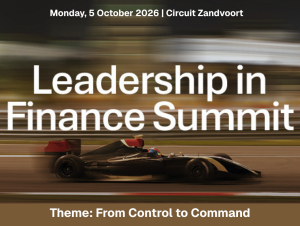
Imagine a Formula 1 circuit. Everything revolves around control: data, sensors, dashboards, engineers. But winning is not driven by data alone.
The difference is made through decisions taken both before and during the race.








Populair


Markt Update


Whitepapers


Vragen over adverteren?

Kan ik je van dienst zijn met advies? Bel of mail gerust. Ik neem graag de tijd voor je.
Wendy Batist
Accountmanager